Oblate Voices is a JPIC blog that follows stories of hope and is about how Oblates and associates live and experience mission work in the spirit of the Oblate founder, St Eugene De Mazenod of responding to the needs of poor and most abandoned around the world.

Monday, February 29, 2016

Young Catholics From Oblate Parish Journey to See Pope Francis


When Pope Francis addressed an estimated 50,000 in the city of Morelia in Mexico recently, present in the crowd were young parishioners from St. Eugene de Mazenod in Tijuana, Mexico. But according to Fr. Jesse Esqueda, OMI, youth minister and group chaperone, mental preparation for this once in a lifetime event started way before leaving Tijuana. Before beginning the trip Fr. Jesse gathered the group on several occasions to study Pope Francis’ writings and encyclicals. He also spoke to them about potential hardships during the trip: flying from Tijuana then driving two and a half hours by car to Morelia; being outdoors in the hot sun; limited access to food and water; and waiting in long lines for restrooms. He reminded the young men that they were ‘pilgrims not tourists’ and a certain degree of sacrifice was necessary for their experience to be successful. When they returned they would be expected to share their experience with others in their home and church community.
Left to right: Miguel Munoz, Alan Walle-(on one knee), Pedro Verdugo, Fr. Jesse, Luis Herrera, Luis Alberto Zepeda
The Oblate Mission in Tijuana, Mexico is a large parish consisting of fifteen communities: one church and 14 chapels. About 200 young people participate in youth ministry, not counting children in the Confirmation program.

The five young men selected for the trip range in age from 18 years to their early 20’s. They are either in college or about to attend college. Two are studying to become engineers. All are discerning a vocation with the Church.

Excitement grew as departure day approached. A day before the event they first traveled by air then drove two and a half hours to the city of Morelia. They spent their free time exploring the city, interacting with other young travelers and praying. One of the young men brought his guitar and played to small crowds. Being in a city renowned for gangs, drug violence, kidnappings and poverty, the young men suddenly realized that while Tijuana was similar to Morelia in many ways, in other ways Morelia’s youth maybe had it even worse.
  

On the big day the group arrived at the stadium at 7AM for an event set to start at 4PM. The crowd was exuberant as they waited to hear the Pope, whose native language, like theirs, is Spanish. Despite long lines for restrooms, limited food and water, and in the words of Fr. Jesse, ‘baking in the sun’ for nine hours, none of the young parishioners complained. Then about half an hour before Pope Francis took to the stage, the energy in the stadium escalated as the crowd sang, danced and waved colorful banners.  


The Pope’s message of hope resonated with an audience of young people eager for words of encouragement. Fr. Jesse said they were overcome with emotions and a few of them shed tears as they listened to the Pope’s message. When young people who were part of the program presented Pope Francis with a list of some of the problems they are facing, he addressed each in a ‘humorous and refreshing way’, noted Fr. Jesse. He described the entire experience as ‘very moving and motivating,’ a moment that ‘ignited a fire’ in them. “We were very impressed with the level of excitement the Pope generated among youth,” he said.


After both an exhilarating and spiritual time, the group returned to Tijuana and has since shared their experience with an audience of at least 120 youth.

Fr. Jesse offered some final thoughts on his experience as Youth Minister at St. Eugene de Mazenod. He described the young men he mentors as very driven with high aspirations. Many come from low-income families. Families offer emotional support but are less able to offer much monetary support. Most of the young men work minimum wage jobs, attend university and keep busy with the church.

Having also worked as a youth minister in California, Fr. Jesse expressed that he sometimes forgets the reality of young people in Tijuana.  He gave the example of their youth meetings, which sometimes extend into the evening. Young parishioners then have to scramble to catch a bus or two, or hitch a ride home. ‘Parents don’t drive up to get them like you would typically see at a California parish,” he said.


Fr. Jesse Esqueda, OMI is in his second year of Youth Ministry at the St. Eugene de Mazenod parish in Tijuana. Prior to that he served as youth minister at the Oblate parish of Santa Rosa in Los Angeles, CA. He has BA degree in Philosophy from D’Youville College and made his vows to become an Oblate in August 2013. He was ordained a priest in May 2014 and received his M.Div. from the Oblate School of Theology in San Antonio, Texas. For his pastoral internship, he spent a year at the St. Jude Shrine in New Orleans. He also served as a lay missionary in Honduras.


Tuesday, February 16, 2016

Three Parishes Walk Together To Defend Human Life

Dr. Carlos Hernandez, MD runs a women’s clinic in Eagle Pass, TX and has done so for the last 18 years. He is also a parishioner and serves on the leadership council at the Sacred Heart Parish, Diocese of Laredo.

Like other pro-life advocates around the country, January 22nd is an important date for Dr. Hernandez. This date marks the anniversary of Roe vs. Wade, a U.S. Supreme Court ruling 43 years ago that legalizes abortion under the constitution. Since this ruling became law, pro-life advocates have worked to overturn Roe vs. Wade by organizing marches and other events on or around January 22nd every year. The largest of these gatherings is the March for Life, which draws tens of thousands of participants to the National Mall in Washington, DC every year. These nationwide events aim to call attention to the sanctity of life and the need to respect human life.

  
Dr. Hernandez recently spoke with JPIC staff about a pro-life event he organized in his community:

For the last 20 years parishioners from three parishes within the Diocese of Laredo, TX – Our Lady of Refuge, Sacred Heart and Saint Joseph’s -- have actively participated in a local Walk For Life event to coincide with events around the country. Dr. Hernandez has been the event’s organizer for the last six years, working with leadership councils from the three parishes and the local Knights of Columbus.

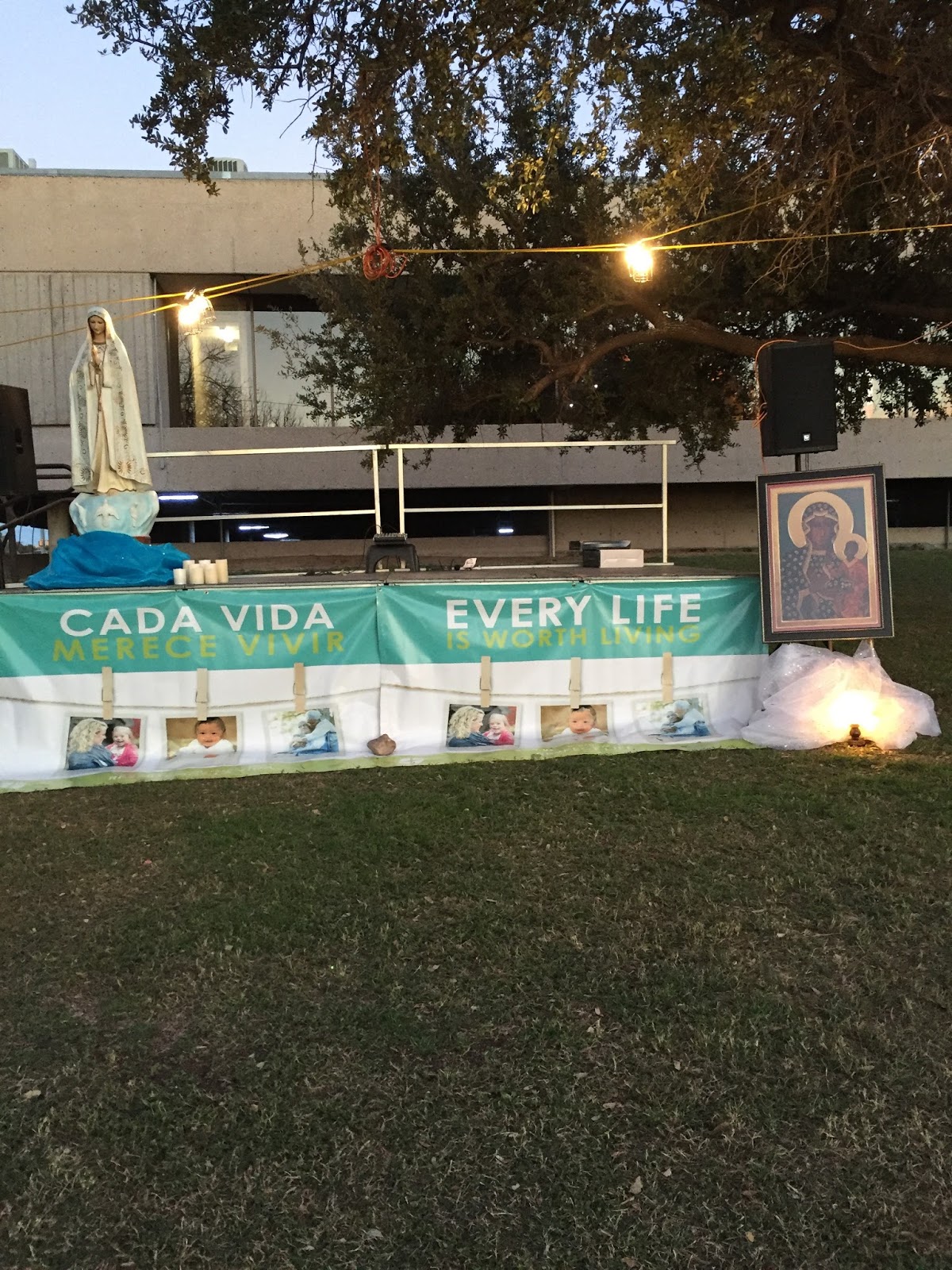
Dr. Hernandez explained that prior to the event and to engage parishioners, a banner contest was held. The winning banner was displayed at the march and the winner received a gift card. Second and third place winners were presented with prizes as well. About 200 people of all ages participated in this year’s Walk. The group first gathered on Main Street in Eagle Pass, then proceeded to walk a mile and a half, praying the Rosary along the way to their final destination at City Hall. The elderly or those unable to walk the full distance waited at City Hall. When the walk concluded, a short program was held and attended by the Vicar of the Diocese, the mayor and other city officials.

Nine days before the Walk for Life event members from all three parishes joined in solidarity with other Catholics around the country in a prayer campaign organized by the U.S. Bishops. The 9 Days for Life campaign called for Catholics to pray for victims of abortion, violence and those suffering from addiction in the nine days leading up to January 22nd.

As Dr. Hernandez personally reflected on the sanctity of life, he shared with JPIC staff
a few local stories and his perspective on the issue from the standpoint of a physician specializing in obstetrics/gynecology. He commended local families who under very difficult circumstances, commit to caring for severely disabled children. He shared a particular story of a young girl born with hydrocephaly - a brain disorder. The child, now nearly 3 years old, was born the very day Pope Francis was elected, on March 13, 2013. 


The child had surgery in Mexico but it failed to correct the problem. Through the assistance of parishioners, the family moved to San Antonio, TX for access to better medical care. Despite surgeries and treatments the child remains in a vegetative state and her condition makes her prone to seizures. Yet her family is very committed to caring for her.  There have been other tragedies in the child’s family. The father passed away from leukemia leaving the mother as the primary caregiver of several other children. As Dr. Hernandez puts it, the child’s mother is ‘doing her best.”

Though the reality of this family is very difficult, Dr. Hernandez remarked that for him, this exemplifies the core of pro-life philosophy that ‘every life is worth living.’

Dr. Carlos Hernandez was born in Colombia, South America. He studied and did his medical residency training in Baltimore, Maryland. He has been in practice for 18 years.


Monday, January 11, 2016

An Interfaith Gathering for Solidarity, Understanding, and Peace

By Sr. Nathanael Lee

Sr. Nathanael Lee is from South Korea and a member of the Little Servants of the Holy Family congregation. She is interning at JPIC's office in Washington, DC.


On December 16th I was privileged to attend an extraordinary event at Georgetown University in Washington, DC. When I read promotion materials I was captivated right away by the event’s title: “An Interfaith Gathering for Solidarity, Understanding, and Peace.” This turned out to be among the most inspiring prayer services I have ever participated in.

The world is still reeling from the unspeakable tragedies in the wake of the Paris terror attacks and San Bernardino, CA massacre. These events have further escalated our concerns and worries about security in public places. We have learned from both tragedies that violence of this kind can be unleashed not only on a battlefield, but also against regular civilians going about their normal lives. These tragedies have also made us feel angry, fearful and suspicious of people we perceive as different from us.

During these difficult and stressful times we need interfaith events like these more than ever. We are witnessing an increase in terror attacks on a global scale, and Mr. Donald Trump’s recent statements calling for a ban on all Muslims traveling to the U.S. have resulted in further backlash against the Islamic community. This is why I felt so honored to be a part of an interfaith audience that stood together for solidarity, understanding, and peace.

At some point during the event each faith representative read from their religious book and offered prayerful reflections in their own way. It was thrilling to see them all on one stage praying TOGETHER and conveying the following messages: we respect you, we listen carefully to what you are saying, we call you friend, and we stand with you. 

Adding to the excitement and to the surprise of many present, Vice President Joe Biden showed up and gave a great “This is America” talk. Please see the video here at http://www.georgetown.edu/joe-biden-interfaith-event-2015.


I was pleased that it was an interfaith prayer gathering and not an academic seminar that motivated and moved me so greatly.


Towards 200 Years of Missionary Oblates of Mary Immaculate


“In solidarity with persons of goodwill, especially those, Christians and Non Christians alike, who are dedicated to the pursuit of Justice and Peace, we commit ourselves to a dialogue with society”

(Witnessing as Apostolic Community# 24)


*Photo Courtesy by OMI Assumption Province-Canada

Friday, January 8, 2016

1816 - 2016: 200 Years of Missionary Oblates of Mary Immaculate


Action on behalf of justice is an integral part of evangelization….Whatever their work, Oblates will collaborate, according to their vocation and by every means compatible with the Gospel, in changing all that is a cause of oppression and poverty.” 

(OMI Rule 9)


Monday, December 28, 2015

The Eternal Stranger: Ministry with Migrant Farmworkers

(Reprinted with permission from OMI Lacombe Canada)

Every spring, as monarch butterflies begin their long journey from Mexico to Canada, they are followed by tens of thousands of human migrants. They come, summer after summer, to harvest fruits, berries and vegetables, low paid work for which few Canadians are interested in applying. The migrants, mostly Mexican men, are part of the Season Agricultural Worker Program (SAWP). Their labour and low wages help keep Canadian agri-business competitive and Canadian produce relatively cheap.


A “generic” photo of a farm worker taken from a farm outside Manitoba. This is the photo we use on most of the publicity for the Migrant Workers Solidarity Network.
One of these men is Antonio. Antonio had been coming to Canada every year for over 20 years, usually arriving in April and returning home in December – the maximum stay allowed under the program. He leaves behind his wife and family – only those who have wives and children are allowed into the program. Although Antonio spends most of his life in Canada, he will never be allowed to become a permanent resident or to bring his family.


Thomas Novak with his guitar and members of the choir of SAWP workers.
Life in Canada is lonely and the work difficult. But Antonio hopes that, after paying his expenses in Mexico and Canada, he can put aside enough cash to pay for the education of his children. Others are saving to buy a little house or a small business – all depending on the quality of the harvest and the number of hours they are able to work. Over the years Antonio has learned a little English, but there is little opportunity to practice. Antonio and his co-workers live in a kind of barracks, 50 km from the nearest major town. The program does not provide for language classes; the work days are long and Antonio has little opportunity to interact with people other than his co-workers and bosses. The workers remain eternal strangers in the country where they spend so much of their lives. At the same time, those who stay in Canada for the full term of 8 months per annum, become strangers to their families back home. Antonio has missed the birth of his children, their birthdays, their graduations and the funerals of his parents.
Oblates in British Colombia (Otto Rollheiser) and in Manitoba (Thomas Novak) have been part of ministries that befriend and support workers like Antonio. As a student at St. Paul University in the 1980’s, Thomas studied the liberating leadership of Cesar Chavez, founder of the United Farm Workers. Chavez led many successful actions to improve the working conditions of Mexican and Mexican American workers who harvest the fruit and vegetables of California and Texas. Today Thomas coordinates a volunteer ministry to another generation of Mexican farm workers; it is based out of Winnipeg’s St. Ignatius Hispanic Catholic Community.
During the harvesting season, Thomas organizes monthly celebrations of the Eucharist in Spanish for Mexican workers in Portage la Prairie and in the village of St. Eustache. The goal of the ministry is not just to provide religious services but to address the isolation of the men, to help them make some contact with the community and to give them a sense that they are cared for and that they are valued for more than for their labour. Thomas and other volunteers visit with the workers on Friday evenings when they are driven into town to do some shopping and their banking. The volunteers try to address any problems that the workers bring to their attention. Every year the ministry organizes special celebrations around Mexican Independence Day (September 15). The celebrations include a supper prepared by the parishes in Portage and St. Eustache and soccer matches between teams from the larger farms.
In 2009, Thomas co-founded the Migrant Workers Solidarity Network. The MWSN is a more political coalition that educates Manitobans about the realities lived by migrant SAWP workers like Antonio. Its members also campaign for better working conditions for the workers. They have successfully lobbied Manitoba’s NDP government to assure that SAWP workers are covered by the provincial medical health plan. In 2015, MWSN volunteers began organizing language classes at two of the farms.

Choir composed of Mexican SAWP workers at a Spanish language Eucharist at St Eustache.
There remains much to do. Although SAWP workers pay the same taxes as Canadian residents, they receive few of the benefits received by other workers. They pay into the national Employment Insurance plan, but cannot collect benefits. Most provinces still deny them participation in provincial Medicare plans. In 2013 the Harper Government stripped SAWP workers of the possibility of applying for the child tax benefit. Workers in most provinces are subject to abuse by recruiters and may be removed from the SAWP program if they are suspected of communicating with a union organizer or otherwise stand up for their rights.
Another generic photo of workers doing typical harvest work (from outside Manitoba).
If you would ask Antonio what would be the change he longs for most, he (and many of his co-workers) would say that it would be the opportunity to bring his family here and to make Canada his permanent home. The MWSN is linking up with like-minded coalitions across the country to encourage the new federal government to provide a pathway to permanent residency for all temporary workers. The rallying cry is “Good enough to work here, good enough to live here”.
The volunteer work that Thomas does among migrant workers is another way that Oblate priests, brothers and associates of OMI Lacombe Canada seek to be present to those who have been pushed toward the margins and, like St. Eugene, to help them to appreciate their dignity as beloved children of the Creator.

Wednesday, December 2, 2015

Marching for the Environment: Events Held Worldwide

By Sr. Nathanael Lee

Sr. Nathanael Lee is from South Korea and is a member of the Little Servants of the Holy Family, a congregation based in Korea. She is interning at JPIC's office in Washington, DC.


On November 29th the Global Catholic Climate Movement held a march in Washington DC, just a day before the official start of the Paris Climate Summit  or COP21. The event coincided with other climate gatherings around the world.

This event made history! It was the largest climate mobilization ever. Over 785,000 people participated in 2,300 events in 175 countries. And I was one of them! 


On the day of our event it was raining slightly, a bit chilly, with memories of my recent Thanksgiving holiday meal left far behind.

Our local crowd that gathered at the White House was modest, not as many as I expected. The thought ran through my head that I forgot to bring the OMI-ecology banner!


Pope Francis' latest encyclical on the environment, Laudato Si' not only calls on the Church but the world as well to acknowledge and do something about our environmental crisis. This is a pivotal issue that affects the poorest and most vulnerable people in our common home, the earth. 

My home community in South Korea, Little Servants of the Holy Family– Justice & Peace Office (LSHF-JPIC) and The Missionary Oblates of Mary Immaculate – Justice & Peace Office (OMIJPIC) in Washington, DC where I currently intern, share a common spiritual philosophy: care for the poor and among the poor. My background and presence here at OMI JPIC encourage me to live out this charism with radical commitment. 


I have attended many climate change seminars, both scholarly and theological in nature. But participating in the recent Global Climate March on the behalf of LSHF-JPIC & OMI-JPIC has personally impacted me to take ACTION and do a little more to move things along.


 "I want the Church to go out to the streets." Pope Francis